Trip to view the Annular Eclipse
in Tamarindo, Costa Rica
December 2001
 Tamarindo was chosen because it lay close (about 50 km north) to the mid-line
and there was a package tour from the UK, with Kuoni, that just happened to be
there at the right time - some other eclipse chasers in the UK we know had the
same idea, though it turns out that they thought of it first .
Tamarindo was chosen because it lay close (about 50 km north) to the mid-line
and there was a package tour from the UK, with Kuoni, that just happened to be
there at the right time - some other eclipse chasers in the UK we know had the
same idea, though it turns out that they thought of it first .
The first few days were spent in San Jose doing some of the tourist things -
Irazu volcano which was swamped in cloud and rain, the rainforest (aerial tram) which was
undeniably forest but sadly also rain, as well as a walking tour of central San Jose (in the
rain).
The flight to Tamarindo, on a Cessna Grand Caravan, had a limit of 12 kg
personal allowance so we had to cut down on the amount of equipment taken to one
tripod and a very limited selection of cameras.
The days in the resort were spent looking around for a good viewing position,
making sure we were around at "eclipse time" to see where the sun
would be and where it would set - we had a good idea already where the sun would
go down as we knew the
bearing of the setting sun and we brought a compass. You can see the setting in
the picture below, taken the day before the eclipse.
Our eclipse trips need to have something special about them just in case we
don't see the eclipse, so a couple of outings were planned:
1. Turtle watching - Close to Tamarindo is one of the nesting beaches of the
Leatherback turtle and we were fortunate to see a couple of these going about
their business. One was thought to be a male as it just "hung around"
a while before heading back to the water the other was a female. We saw her
digging the hole, laying eggs and re-filling the hole, patting down the sand as
she went along. The eggs were removed as quickly as they were laid by rangers
who incubate them elsewhere then release the baby turtles back into the sea for
a higher success/survival rate. There was nothing about these egg removers to
demonstrate that they WERE rangers - in fact their clothes suggested quite the
opposite and putting the eggs into a supermarket bag didn't lend a lot of
credence to the "official" removal of turtle eggs.
2. A trip on the Tempisque River on the outskirts of Palo Verde National Park
- Here we viewed many birds (numerous types of Heron, Egrets, Roseate
Spoonbill), crocodiles, Iguanas and some monkeys.
Eclipse Day - 14 December 2001
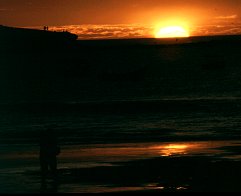 The
morning started reasonably sunny, but with broken cloud, as it has been all the
time we have been here on the coast. Our friends from the UK were in a hotel
further down the beach and had chosen a site on the beach, beyond the headland,
to view the eclipse - as seen on the adjacent photo taken the day before, at
sunset.
The
morning started reasonably sunny, but with broken cloud, as it has been all the
time we have been here on the coast. Our friends from the UK were in a hotel
further down the beach and had chosen a site on the beach, beyond the headland,
to view the eclipse - as seen on the adjacent photo taken the day before, at
sunset.
We thought we would take a look and join them if it were suitable - a kind of
"we all see it or we all miss it".
Sadly, the site didn't suit us - because of the limited luggage allowance, we
only had one tripod and the video was to sit on a "table-top" tripod
requiring a sturdy surface to hold it, which the beach didn't have, so we were
back at site one (our hotel grounds) where a good surface was almost guaranteed.
The sun shone throughout the day, sometimes in a clear blue cloudless sky,
sometimes not!
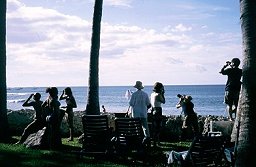 We decided to set up an hour before first contact to make sure we got our
optimum viewing position, which we didn't - a Japanese group had already
commandeered the area. (Note: Anyone who went with Explorers Tours to India in
1995 will smile at that). We opted for second best place, which admittedly
was only about 5m to one side, but any further away would have been awkward.
We decided to set up an hour before first contact to make sure we got our
optimum viewing position, which we didn't - a Japanese group had already
commandeered the area. (Note: Anyone who went with Explorers Tours to India in
1995 will smile at that). We opted for second best place, which admittedly
was only about 5m to one side, but any further away would have been awkward.
All went well during the partial phases - as our
photographs show - until fifteen minutes to annularity, when a big black
cloud rolled in and did not roll out. Odd glimpses were seen of the sun, but not
at the time when it really mattered.
The indoor/outdoor thermometer came with us again and on this occasion we saw
only a 3 degree C drop from 30.5 to 27.5 - small but noticeable - all in the
shade, of course.
 We could see
down the beach to the headland, and we could see the sun on it - bother.
We could see
down the beach to the headland, and we could see the sun on it - bother.
Fifteen minutes after the event the clouds moved enough for us to see the sun
for a while longer, before they gradually engulfed it again and deprived us of
an eclipsed sunset - a double whammy, so to speak!
Of course, later that evening over a drink it is confirmed that 800m down the
beach at the headland and beyond annularity was seen, for about a minute and a
half - so the drinks were a mixture of celebration and commiserations.
 We
caught a couple of eclipse reports on the local television that evening and none
of them showed a fully annular eclipse - in fact the reports and images being
displayed suggested that most of Costa Rica missed it. It didn't stop them
trying to make a big thing of it, like the BBC did in 1999, with "edited
highlights".
We
caught a couple of eclipse reports on the local television that evening and none
of them showed a fully annular eclipse - in fact the reports and images being
displayed suggested that most of Costa Rica missed it. It didn't stop them
trying to make a big thing of it, like the BBC did in 1999, with "edited
highlights".
The press reports the next day gave the same impression of a missed eclipse
with headlines such as "the eclipse no-one saw" and "the obscured
eclipse" (these are very liberal translations of the Costa Rican headlines
by someone whose Spanish is limited to yes, no, thank you and two beers
please).
The cartoon published next day gave some indication of the non-existence of
the event - While the tourists ask "where is the eclipse?" the local
replies "An early Happy Day of the Innocents" (The Latin American
version of the UK "April Fool").
June 2002 is another sunset eclipse, only more so with annularity less than
one degree above the horizon. This will be viewable from Puerto Vallarta in
Mexico, also at a time of transition between dry and wet seasons.
Do we want to be disappointed again? Ask again around March 2002.
Return to Costa Rica travels
Author: Andrew J White
©2002 Val and Andrew White